The electrification of transport in Europe has entered a new phase.
For passenger cars, fast charging is becoming part of everyday life: on long journeys, at shops and in busy public spaces. For vehicle fleets, buses, service vehicles and freight transport, it’s more than that. Charging must fit in with timetables, vehicle rotations and agreements with customers.
At the same time, electricity consumption is rising. In July 2026, the International Energy Agency (IEA) predicted that global electricity consumption would grow by 3.6 % in 2026 and by a further 3.8 % in 2027, driven by industry, transport, cooling and data centres. The charging infrastructure adds a new dimension: high consumption concentrated in one place, and often at the same time.
That is why fast charging has become a question of infrastructure. Where the chargers are located remains important. The challenge lies in delivering sufficient power – quickly, reliably and in a way that allows for future expansion. This is most evident in the heavy goods vehicle sector. A haulier cannot afford long charging stops, and the shorter the stop, the more power is needed to recharge without disrupting operations. This applies, incidentally, wherever time is of the essence, and in such cases it is the infrastructure behind the charger that determines whether the whole system works.
Freight transport is the real test
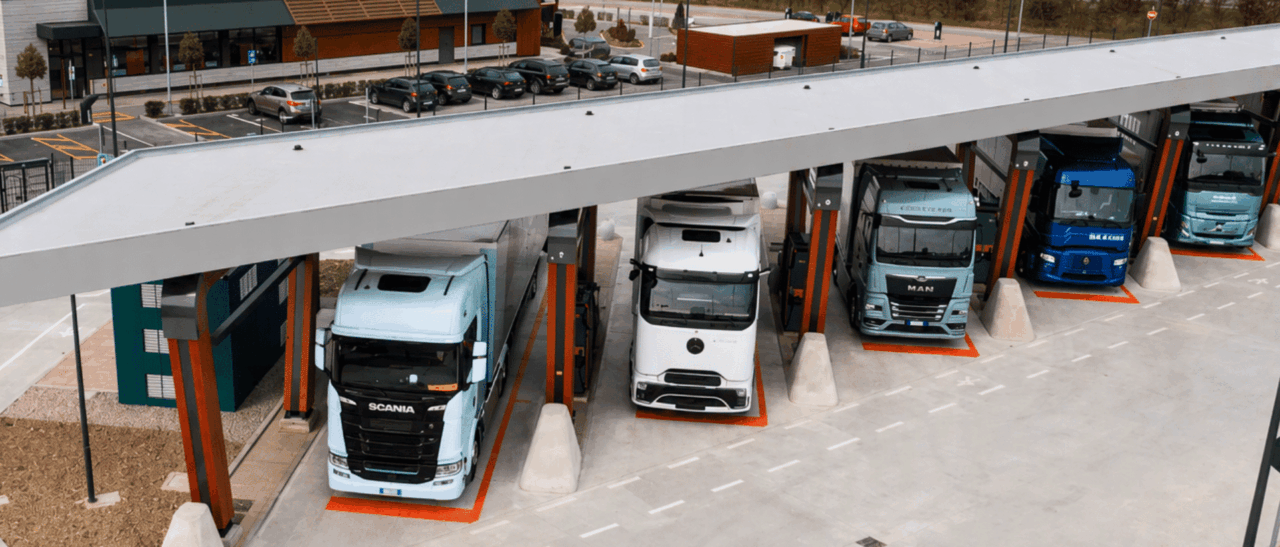
An electric lorry has completely different requirements to a passenger car. On long journeys, the charging must fit in with the vehicle’s operating cycle. High-power DC chargers already deliver several hundred kilowatts, and the Megawatt Charging System (MCS) is set to exceed 1 MW. The aim is to get enough energy during a short stop to keep the vehicle moving.
How long can your lorries remain stationary whilst charging before it starts to affect operations?
Freight transport isn’t the only area where fast charging is used, but it is often the most demanding. This is where all the challenges come together at once: high power, short charging times, lots of vehicles charging simultaneously, a limited grid, tight spaces and a need for scalability.
The TSG Group has been involved in several projects that demonstrate what is required in practice. In Spain, TSG has helped to establish the first MCS facility for heavy-duty vehicles at Grupo Disfrimur, with a capacity of up to 1,440 kW. In France, TSG has supplied a charging station at the depot of Gautier Fret Solutions. This is a 400 kW installation, which can be expanded to 600 kW, featuring a 1,250 kVA transformer and the entire electrical installation, designed to meet the fleet’s current operational needs and future growth.
The two projects point the same way. Electric freight transport depends on lorries and chargers, but just as much on the infrastructure that connects them and supplies them with power.
The infrastructure behind the charger
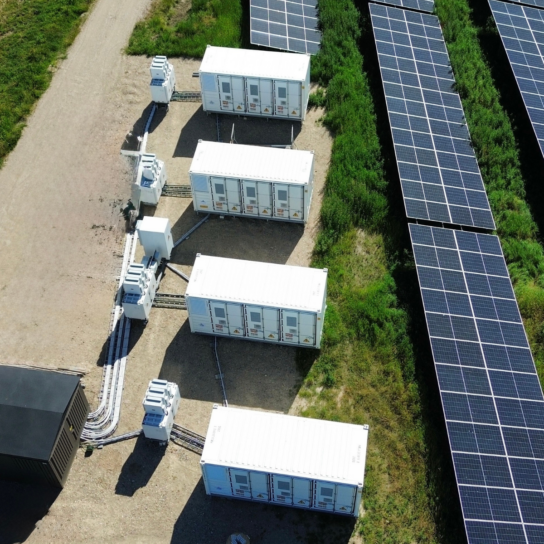
A high-power charging project is, first and foremost, an electrical project. Before the first charger is installed, it is essential to know how much capacity the grid has and what future demand will be. Depending on the location, this may involve a new grid connection, medium- or high-voltage systems, a transformer, distribution equipment, a battery, solar panels, civil engineering works and digital monitoring.
The transformer plays a key role. It must be sized to cater for the site’s total consumption and any future expansion, rather than just the chargers. This becomes even more important when several vehicles are charging at the same time, or when the charging network is set to grow over time.
You can’t just add up the chargers’ power ratings and call it a design. Load profiles, concurrent usage, grid constraints and the way the vehicles are actually used all need to be taken into account.
How much capacity can your connection provide when the entire fleet returns at the same time?
Space is also important. Lorries must be able to drive in, turn round and park, and chargers, technical rooms and transformers must be positioned so that operations are safe and efficient. At petrol stations and charging hubs, this also affects customers’ experience of the site.
That is why TSG Charge is delivered as a turnkey solution: from technical design and regulatory approval to grid connection, electrical and civil engineering works, commissioning and maintenance for many years to come. Where the project requires it, the solution includes a transformer, battery, solar panels and energy management.
When the grid cannot supply enough
One of the biggest bottlenecks is grid capacity. Even when the need is clear and the location is suitable, the local grid cannot always supply the required power. Upgrading the grid takes time, and in the meantime, operations have to wait.
This is where flexibility makes a difference. An on-site battery is charged when the load is low or when the solar panels are producing more than the site uses, and supplies power when the vehicles need charging. This takes the peak off the load and makes better use of the connection you already have.
A battery can provide you with power now, whilst you wait for the grid to be upgraded.
In Denmark, we supply battery systems and solar panels in partnership with our sister company, NRGreen. Read about battery systems at NRGreen →
Energy management gives you even more control. When consumption across the entire site is measured continuously, the charging power can be adjusted according to the available capacity, which vehicles need to leave first, and what else is drawing power.
The TSG Group’s EnergyHUB platform brings it all together in a single cloud-based system: chargers, the grid, solar panels, batteries, the building’s installations and other energy systems. The operator can monitor, control and optimise energy across the entire site through dynamic load balancing, peak shaving and better utilisation of the electricity the site generates itself.
So a charging site is not defined by its installed power alone. It also depends on how intelligently that power is managed. In the Netherlands, TSG and Pixii have installed a 150 kW fast charger with a battery at a site where the grid connection is only 40 kVA. The battery makes the charging process independent of the grid’s limitations, and the site is now capable of something it otherwise would not have been able to do.
A 150 kW fast charger connected to a 40 kVA supply. It’s the battery that makes it possible.
From the depot to the motorway
Fast charging takes different forms, depending on where and how the vehicles are being driven. At a depot, charging follows the fleet’s schedule, so that vehicles charge whilst being loaded, unloaded or taking a break. Along major transport corridors, public charging hubs must be able to accommodate many vehicles with minimal waiting times. In mixed-use locations such as a petrol station, the fast charger shares space with a shop, fuel pumps, solar panels and payment facilities, and everything must work together seamlessly from a technical perspective.
This is evident in the Group’s projects across Europe. In the Netherlands, TSG has delivered WattHub Geldermalsen, a large charging hub for electric lorries and construction machinery, featuring 36 Kempower Satellite chargers, six 600 kW transformers and a total capacity of 3.6 MW. In Italy, TSG has assisted Milence with the company’s first charging hub in the country, located at Bagnolo San Vito near the A22 motorway. It features 400 kW of charging infrastructure, is MCS-ready and forms part of a wider European corridor strategy for electric freight transport. In addition, there have been previous projects in Germany and Spain.
There is no set template. Each location must be designed according to how it will actually be used, whether it is a private depot, a public corridor or a hub for multiple forms of energy.
What does this mean in Denmark?
Most hauliers do not replace their entire fleet all at once. At the depot, diesel, HVO, gas and electric vehicles will operate side by side for many years, and charging must fit into the existing operations. That is the reality we design for.
Diesel, HVO, gas and electricity will be used side by side at the depot for many years to come.
At TSG in Denmark, a charging project therefore begins with your routes, your depot and the capacity available at your connection point. From there, we design the solution, install and commission the chargers, and service them afterwards. You own the chargers, and the electricity is supplied directly to you. The chargers can also be integrated with the fuel and fleet management systems you already have with us.
You can see how this works in practice at Orkan in Iceland, where fuel and charging are part of the same system. Read the Orkan case study →
Build for the next generation
High-power charging infrastructure is an investment that needs to last for many years. Lorries are evolving, fleets are growing, and charging needs are becoming greater and more complex. The infrastructure must therefore be built with room for more: more chargers, higher power, more vehicles at once, and a network that evolves over time. This requires that grid connection, transformers, distribution, chargers, batteries, solar panels and energy management are planned together from the outset.
Over time, the TSG Group has built up expertise in electric mobility, electricity infrastructure, solar energy, battery storage and energy management, both through organic growth and through acquisitions in Europe. The Group has installed over 55,000 charging points in 30 countries. With local technical teams in each country, we can deliver the complete solution close to the customer.
As fast charging becomes more widespread, charging points are turning into small energy hubs, and how well they function depends on how the energy is managed and balanced over time. For a haulier, it ultimately comes down to getting the right amount of power into the lorry at the right time so that it can get on the road.
This article is based on the TSG Group’s article “Fast Charging Infrastructure: Building the Energy Backbone of Electric Mobility” from 22 September 2026.