Case
The sheer range of benefits offered by the powerful new Tokheim EYE system are already being realised by one of the first UK service station businesses to install it: Ron Perry & Son’s two service stations located on the A19 near Hartlepool. As a long-established business in the north of England, Ron Perry & Son has been operating here for over 40 years, with three generations of the Perry family involved.
Switching from analogue to digital
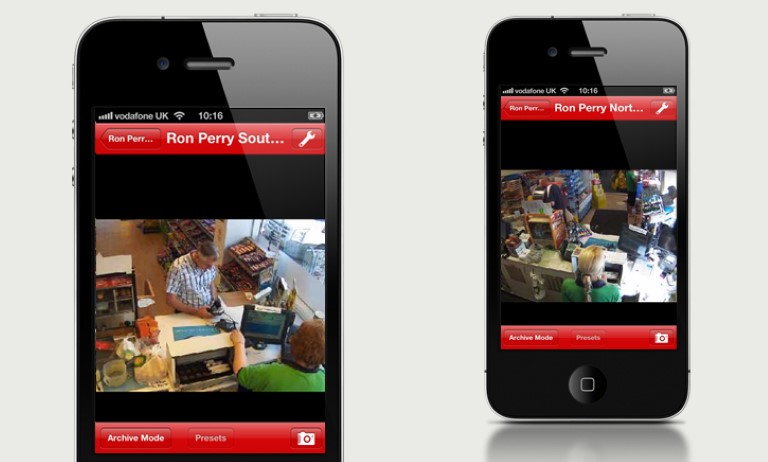
The current owner, Ron Perry, son of the business’s founder, has expanded the northbound and southbound facilities to include forecourt shops and a café at each site. With such a wide range of key operations to maintain, protect and manage, Ron concluded that the existing seven-year-old analogue CCTV system was no longer providing sufficiently detailed images or adequately monitoring the required areas of the sites – including the fuel pumps. His long-standing relationship with TSG led to the installation in September 2012 of the Tokheim Eye system, and within six weeks it had already demonstrated its value in a multitude of ways.
On a mobile, tablet, desktop or laptop
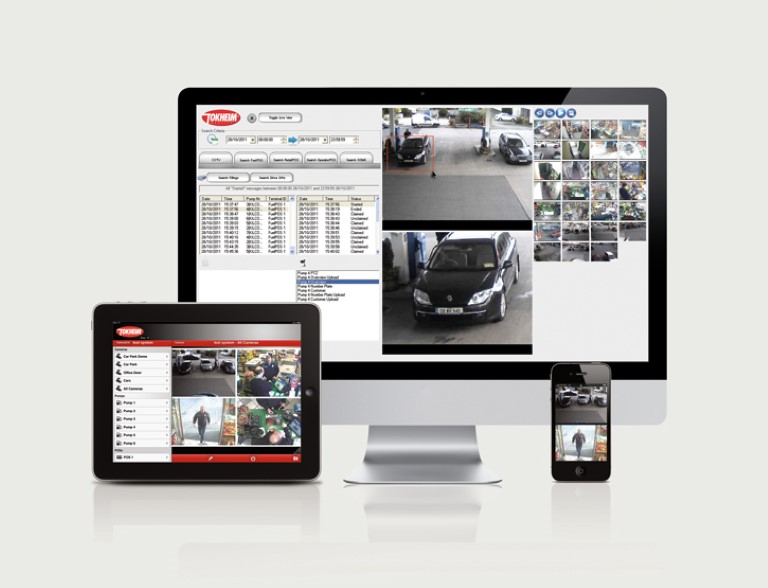
A trial involving two IP dome cameras positioned above the till areas in the retail shops, linked to Ron’s desktop computer in his office on the southbound site, as well as his smartphone, has given him an insight into just how useful a fully rolled-out system could be. “The images and data I have already seen have been invaluable in identifying operational management improvements we can make. For instance, reviewing staff activity when a recent drive-off incident occurred showed that we could introduce changes to maximise the chances of such incidents being spotted and take appropriate action in future.”
“On a day-to-day basis, it has enabled me to spot when queues build up in the shop and adjust shift patterns to minimise inconvenience for our customers. If I want to search for any kind of incident, it is now much quicker and easier because you can ask the system to search using criteria such as the last refuelling, the last cash payment, by receipt, date, time, etc.”
“For example, a customer rang us to ask whether he had driven off leaving an item on our shop counter whilst paying, and we were able to quickly find the relevant footage using the new shop cameras simply by asking him for some basic information over the phone. Previously, that would have been very time-consuming due to the lack of integration between the cameras, the petrol pumps and the till systems. We have also used the high-definition (HD) dome cameras to search for till receipt data for transactions where there has been a query regarding the payment, as it is actually quicker to use the surveillance system to find the receipt details and resolve any dispute.”
Number Plate Recognition (ANPR)
Inspired by the potential of Tokheim EYE, Ron expanded the system with IP HD cameras installed on the forecourt to monitor the pumps and maximise the value of a fully integrated system for his two sites. To help further enhance security, an automatic number plate recognition (ANPR) module was added. With this module in place, number plates are digitally read by the camera; the benefits include the ability to build a number plate database for blacklisting vehicles involved in previous drive-offs, thereby thwarting potential thieves before they can leave with stolen fuel and thus protecting the company’s bottom line.
One drive-off incident has already been investigated, and images of the culprit were ‘exported’ onto removable media and handed over to the police, who were then able to show the evidence to the driver in question. The result? He returned to A19 Services and paid the fuel bill. “We have found that Tokheim Eye is so demonstrably useful that the police have recognised the system’s capabilities and are very keen to make the most of them. If they can use the evidence to prosecute for one incident, there is often a chance that the person or vehicle can be linked to other offences. For instance, a car involved in a recent drive-off was later found to have been stolen as well.”
Tackling shrinkage
When it comes to tackling shrinkage, Ron expects the system to also provide a quick way of identifying anomalies, including voids, refunds and high numbers of returns. “The system is so powerful and easy to use that it proactively issues warnings and provides the relevant data and visual evidence as a single package. This means that problems do not slip through the net and can be investigated without it being the time-consuming task it used to be,’ he explains. “It also allows me to keep an eye on the staff. Because I can view the CCTV remotely, they don’t know whether I’m watching in real time or not. Every business has issues with staff, and you have to place a great deal of trust in them. I now have a better idea of what’s going on. We lose about £2–3,000 a year to drive-offs, and whilst it’s too early to say whether the system has put a stop to that, it’s definitely a deterrent.”
The system is so powerful and user-friendly that it proactively issues warnings and provides the relevant data and visual evidence as a single package. This means that problems do not slip through the net and can be investigated swiftly.
Images on EPOS help prevent mix-ups
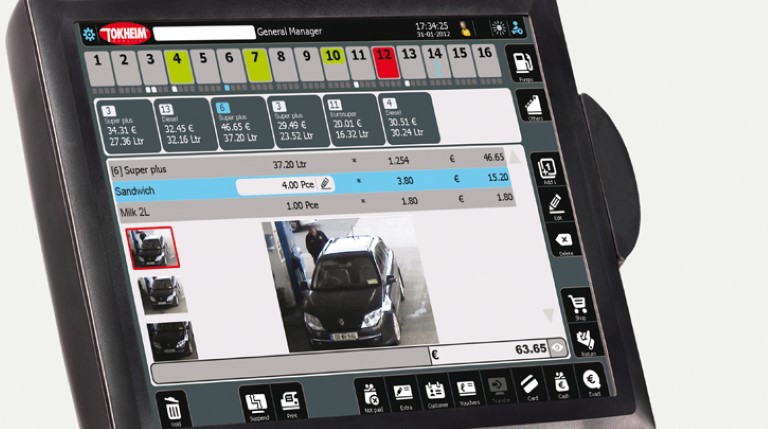
The technology has put a stop to motorists giving cashiers the wrong pump number and, whilst drive-offs were not a major problem at Ron’s sites, it also prevents thieves from targeting his forecourts. “When the customer pulls the nozzle out, the system takes a photo of them and records them throughout the transaction. When they tell the cashier their pump number, a photo of them appears on the till screen so staff can check whether it is the correct person. On a busy forecourt, customers can easily give the wrong pump number, and the cashier ends up charging the wrong amount. If someone has forgotten to pay, you can easily see at which point they forgot,” adds Ron.
Expanding the modular system
“The expansion of Tokheim Eye at the A19 Services is facilitated by the ability to add elements to the system when investment funds allow and circumstances require. “For me, the beauty of this is that I do not have to fund the entire installation in one go, meaning it is flexible, versatile and ‘future-proof’, because we can make changes as events unfold in the future.”